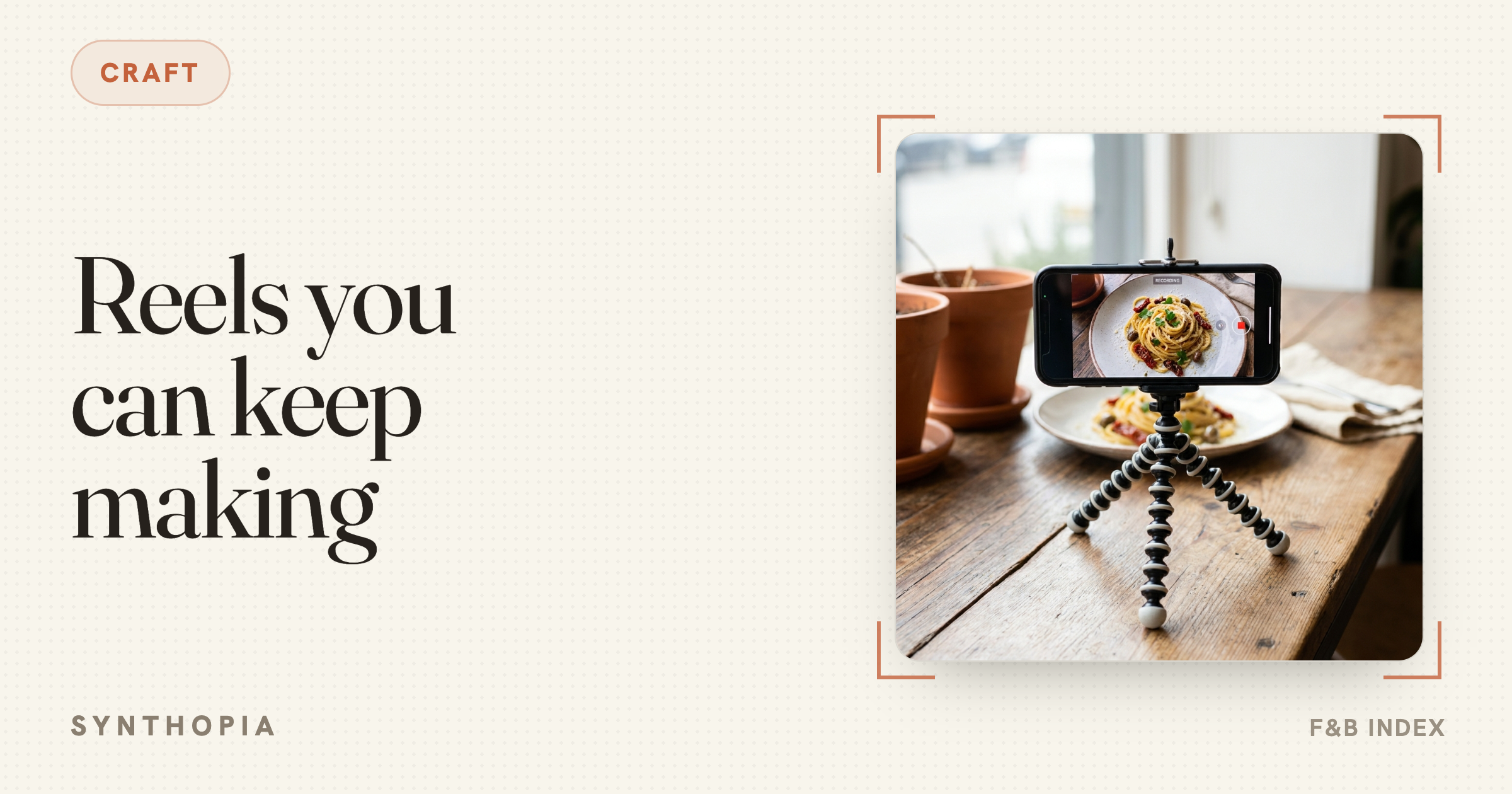
The app is almost never the reason a restaurant's reels are bad. The footage is. But you still
have to pick an app, so here are ten of them with what they cost and what each one actually
does.
Prices were checked against each vendor's own pricing page on 5 September 2026, and where a
vendor does not publish one, this page says so instead of guessing.
The shortlist
| App |
What it does |
Free |
Paid from |
Best for |
The catch |
| CapCut |
Manual editing, trending templates |
Yes |
Not published |
What most restaurants already use |
No price on its website anywhere |
| Instagram Reels editor |
Cutting, audio, captions, in-app |
Yes |
Free |
Posting today with no other tool |
Basic, and it keeps your footage inside Instagram |
| Canva |
Design plus simple video |
Yes, 1 user |
$15/mo Pro |
One person doing stills and video |
A design app first; video is the newer half |
| Adobe Express |
Quick cuts, templates |
Yes |
$9.99/mo |
The cheapest paid editor here |
One social account per network on free |
| InShot |
Phone editing, fast |
Yes, watermarked |
App-store pricing |
Editing on the pass between services |
Watermark on free, and it is a phone-only workflow |
| VEED |
Browser editing, subtitles |
Yes |
Published, not verified here |
Subtitles without a phone |
We could not extract its tiers on 5 Sep; check before buying |
| InVideo |
AI-generated video |
No |
$17/mo Plus |
Volume of generated clips |
750 credits, and unused credits do not roll over |
| Predis.ai |
AI posts and short video |
Trial only |
$24/mo Core |
Social video at volume |
About 9 videos a month, and it draws food that is not yours |
| Later |
Scheduling reels, visual planning |
14-day trial |
$18.75/mo |
Planning the grid |
30 posts per profile on Starter. It schedules, it does not cut |
| Synthopia |
Reels built from your own footage |
60 credits, no card |
$39/mo |
The month made, not the clip |
Newer than everything above, and we built it |
Two of those rows are things we found rather than copied. CapCut, the app most restaurants
actually use, publishes no price on its website. Its pricing page 404s and the main site
carries no figure, checked 5 September. And InVideo's credits expire monthly, which matters
more than the headline: 750 credits you cannot bank is a different product from 750 you can save
for a launch week.
The four routes, honestly
Cut it yourself. CapCut, InShot, the Instagram editor. Free, capable, and genuinely what
most good restaurant accounts are made with. The cost is that you are the editor, on a phone,
after service.
Template it. Canva, Adobe Express, VEED. You drop your clips into a shape someone else
designed. Faster, more consistent, and the ceiling is that your reel looks like the template
until you learn to bend it.
Generate it. InVideo, Predis. The machine makes the video. Fast, and for a restaurant the
catch is specific: generated food is not your food. It is fine for a text-led clip, an offer
card, or B-roll of a city. It is not fine for the dish.
Produce it from your own material. The clips you shot, cut to a plan, in your voice. This is
what an agency does and what our own product is for. The honest disclosure: we are in this
category, so weigh what follows accordingly.
What actually makes a restaurant reel work
None of this is an app feature, which is the uncomfortable part of any tool comparison.
The first second. Not a logo. Steam, a pour, a cut, a hand. If nothing moves in frame one,
the rest does not get watched, and that is a shooting decision rather than an editing one.
Sound the platform recognises. Trending audio still carries reach on Instagram and TikTok.
CapCut is genuinely ahead here because it surfaces what is moving right now, and that is most of
why it is the default.
Fifteen to twenty seconds. Long enough to show the thing, short enough to be rewatched. Most
restaurant reels are twice as long as they need to be because the raw clip was.
One idea. A dish, a moment, a person. Three ideas is a menu, not a reel.
Captions. Most feeds are watched muted. Every app here does captions; only some do them
automatically, and it is worth choosing on that alone if you post daily.
Here is the thing every app comparison skips. The constraint on almost every restaurant account
we see is not editing software. It is that nobody filmed anything on Tuesday.
Fifteen seconds of usable footage is about ninety seconds of actual filming: the pour, the cut,
the plate landing, one shot of the room with people in it. Done during prep, by whoever is
already standing there, on a phone, near a window. That is the input. Every app above is a
multiplier on it, and a multiplier on nothing is nothing.
If you fix one thing this month, make it a standing habit of filming three clips a shift. The
app you choose afterwards matters much less than you would think from reading pages like this
one.
What each budget buys
Free. CapCut plus the Instagram editor. This is a completely legitimate answer and it is what
a large share of the best independent restaurant accounts are made with. It costs you the editing
time and it caps at your own patience.
$10 a month. Adobe Express Premium. Templates, quick cuts, automatic captions, and it is the
cheapest paid editor here. Good if design consistency is the gap.
$15 to $20 a month. Canva Pro if you also need stills, which most restaurants do. This is the
best single subscription on the page for a one-person operation, because the same $15 covers the
poster, the story and the reel.
$25 to $40 a month. Now you are buying volume or you are buying time. Predis at $24 for
generated social video if you will police the food. Later at $18.75 if the bottleneck is
planning rather than making. Something that produces from your own footage if the bottleneck is
that nobody has time to cut anything.
Above that you are paying for a person, not an app, and that is often the right call. A local
videographer for one shoot a quarter, giving you sixty clips to cut down all season, is better
value than any subscription on this list.
The ninety-second shot list
If the footage is the constraint, this is the fix, and it does not need an app. Four clips, shot
during prep, on a phone, near a window. Ninety seconds of filming produces a week of posts.
- The pour, or the cut. Something that moves and cannot be faked. Slow it down later.
- The plate landing. Hands in frame, from a low angle, as it hits the pass or the table.
Hands are the difference between a photograph and a moment.
- One wide of the room with people in it, at the hour your light is best. Nobody
identifiable in close-up unless you have asked.
- The hand-off. Whatever your version is: the coffee going across the counter, the box
closing, the bag being tied.
Shoot each one twice and keep the second take. The first is always the one where somebody looks
at the camera.
Film in the highest resolution the phone offers and crop later. You cannot add pixels back, and
a 4K clip cropped to vertical still looks better than a vertical clip stretched.
The audio problem nobody mentions
Trending audio is most of what makes a reel travel, and it is also the part with a legal edge
most restaurants do not know about.
Instagram and TikTok both maintain separate audio libraries for business accounts, and they are
smaller. A track that a personal account can use freely is often unavailable to a business
profile, because the platform has licensed it for personal use only. If you switch to a
professional account and your saved sounds start disappearing, that is what happened. It is not
a bug.
The practical consequence: check the sound is available to you before you cut to it, not
after. Re-cutting a finished reel to different audio is the most avoidable rework in this whole
process, and the apps will happily let you build the thing first.
Original audio sidesteps all of it and is underrated. The sizzle, the grinder, the milk steaming,
the knife on the board. It is free, it is unambiguously yours, and for food it often outperforms
a trending track, because the sound of the thing being made is the thing being sold.
When to still hire someone
Three cases, and they are worth the money.
A launch. New venue, new menu, a refit. You want footage you will use for a year, and one
proper shoot produces a library that every app above then multiplies.
Food that is genuinely hard to shoot. Anything dark, anything in a dark bowl, anything that
collapses in ninety seconds. Some dishes need a light and someone who knows where to put it.
The room, with people in it. Guests in shot, well lit, with releases, at the hour your room
looks best. Almost impossible to catch yourself because you are working during that hour.
Outside those three, the phone is fine. It really is.
The test
Ask which one you will still be opening in March.
The best app for a restaurant is the one whose workflow survives a bad week. CapCut survives
because it is free and already on the phone. A $24 generator survives if the credits match the
cadence you actually keep, and stops surviving the month you needed twelve videos and had nine.
A producer survives short-staffing, which is the specific week most accounts go quiet.
Pick for the cadence you can hold in a bad month, not the one you can hit in a good one. If that
cadence is two or three reels a week, made from footage you shot, Synthopia
builds the first campaign free with 60 credits and no card. If it is one reel a week cut on the
pass, CapCut is free and better at trending audio than we are.
Prices checked 5 September 2026 against each vendor's own pricing page. CapCut's and InShot's
are not published on the web; VEED's did not extract and should be checked directly.