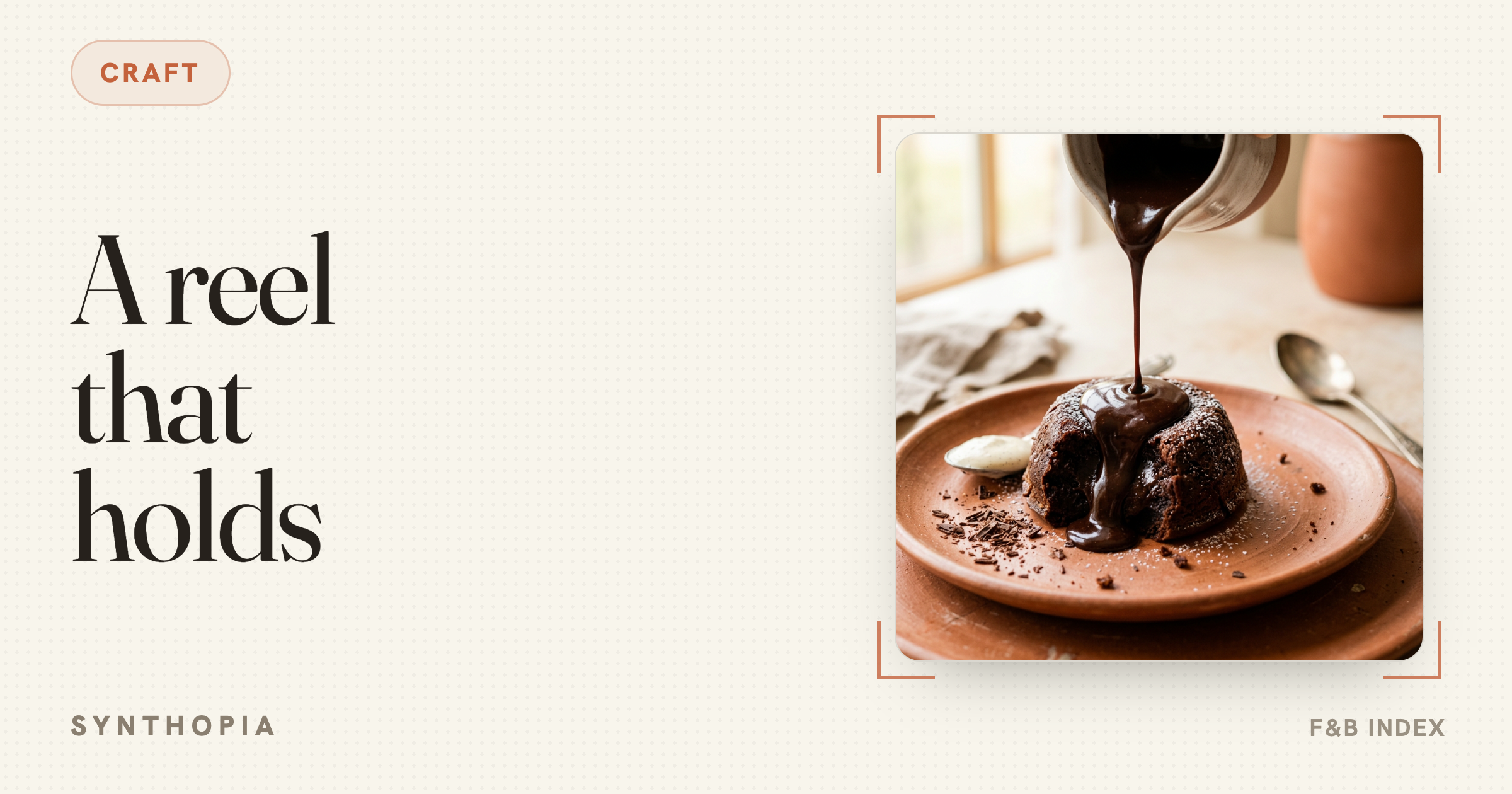
A food reel is won or lost in the first second, not by the song you put behind it. Most clips that get no views are not badly filmed, they are badly opened: a logo, a slow build, the good bit buried at the end. Here is how to capture footage during a normal service that actually holds a thumb.
1080 x 1920 (9:16), 30fps: Instagram's recommended Reels format is 1080 by 1920 pixels at a 9:16 ratio and at least 30 frames a second
2 December: The UAE marks National Day on 2 December
The first frame is the whole game
A food reel is won or lost before the music kicks in. Someone thumbs past your clip in about a second, so the opening frame has to do all the selling. Do not open on your logo, an empty table, or a slow tilt up from the floor. Open on the moment the dish is at its most appetising: the cheese already stretching, the karak already mid-pour, the knife already through the crust. If your best three seconds are buried at the end, move them to the front.
A good test: freeze the first frame and ask whether a stranger would stop for it with the sound off. If the answer is no, you have not started the reel yet, you have started the setup. Cut the setup.
One reel, one action
The instinct is to film everything: the prep, the plating, the pass, the table. Resist it. A reel that holds attention usually shows one clear action done well. Pick the single hero moment of the dish and build the whole clip around it.
For a mixed grill it is the reveal when the lid lifts and the steam goes up. For a burger it is the pull. For karak or a flat white it is the pour. For kunafa it is the cut and the cheese stretch. One action, shot properly, beats ten actions shot in a rush. When you try to cram the entire service into fifteen seconds, nothing lands, because the viewer never gets long enough on any one thing to feel hungry.
Movement that feels intentional
Static clips look flat on a phone. A little motion gives the food depth, but it has to look deliberate, not shaky. Three moves cover almost everything, and you can do all three handheld.
- The slow push-in: start a hand's width back and move the phone steadily towards the dish over two or three seconds.
- The reveal: lift a lid, pour the sauce, or place the last garnish while the camera holds still.
- The top-down: shoot straight down and glide across the plate.
Keep both elbows tucked into your ribs to steady the phone, move your whole body rather than just your wrists, and go slower than feels natural. If your venue has a cheap phone tripod, or even a jar to lean the phone against, use it for the pour shots.
Shoot for the cut
A tight reel is built in the edit, and you cannot edit what you did not film. For one dish, capture four to six short clips of the same moment from different angles and distances: one top-down, one at plate level, one close on the texture, one wide enough to show the hand and the action.
Each clip only needs three to five seconds of usable footage. That coverage is what lets you cut fast later, switching angle every second or so, which is exactly what keeps a viewer watching. Film more than you think you need. It is far easier to drop a weak clip than to go back and re-fire a grill because every angle you shot looked the same.
Settings and framing for vertical
Film vertical, always. Instagram's recommended Reels format is 1080 by 1920 pixels at a 9:16 ratio and at least 30 frames a second, according to invideo's 2026 Reel size guide, so hold the phone upright and shoot at your camera's highest resolution.
Before you press record, tap and hold on the dish to lock focus and exposure so the shot does not hunt and brighten halfway through. Wipe the lens, because kitchens coat everything in a fine film of grease. Leave a little breathing room at the top and bottom of the frame, since captions and the platform's own buttons sit there and you do not want them covering the food. If you want slow motion for a pour, film it at 60 frames a second and slow it down in the edit.
A ten-minute capture routine during service
You do not need a shoot day. You need one dish, one member of staff who is comfortable with a phone, and ten minutes at a quiet point in service. Decide the hero action the night before so nobody is thinking on the spot. When an order for that dish comes up, hold it back thirty seconds, wipe the plate, and fire your four to six clips before it goes out.
Do this a few times a week and you will have a bank of footage without ever stopping the kitchen. A Business Bay cafe can build a month of content off its karak pour and one signature plate, tied to what is coming up: a National Day spread (the UAE marks it on 2 December, per the Ministry of Foreign Affairs), an iftar table in Ramadan, or a dish that travels well for your Talabat listing. We publish the Synthopia F&B Index, a survey of more than 5,000 Dubai restaurants and cafes, and Synthopia turns exactly this kind of raw footage into a finished, captioned reel in your voice. The footage still has to be real, and it has to be yours.
Questions owners ask
How do I make a good restaurant reel?
Open on the most appetising frame, with no logo and no slow build. Feature one clear action, a pour, a cut or a cheese pull, and shoot four to six short steady clips of it from different angles. Film vertical with focus and exposure locked, then cut fast and keep it under about fifteen seconds. The first second decides whether anyone watches, so lead with your best shot.
What should the first second of a food reel show?
The single most appetising or surprising moment, shown straight away. No logo intro, no slow tilt up, no empty plate filling in. Viewers decide in about a second, so the sizzle, the pour or the finished dish needs to be on screen immediately. Save the context for later, or drop it entirely.
How many clips do I need to film for one reel?
Aim for four to six short clips of the same dish or moment, each three to five seconds, from different angles and distances: one top-down, one at plate level, one close on the texture, one wider to show the action. Shooting that much coverage in a single service is what lets you cut a tight, fast-moving edit afterwards, so film more than you think you need.