Founding Pilot — the first 50 brands get 35% off for 12 months, direct founder support, and a hand in shaping what we build next. Claim your spot →
Craft — How to Make Restaurant Videos With AI Using Your Own Photos

Journal Craft 27 July 2026 6 min read Synthopia F&B Index

How to Make Restaurant Videos With AI Using Your Own Photos

The real path from your restaurant's photo library to a usable reel, stills and a carousel, without the fake AI look that invents dishes you don't serve.

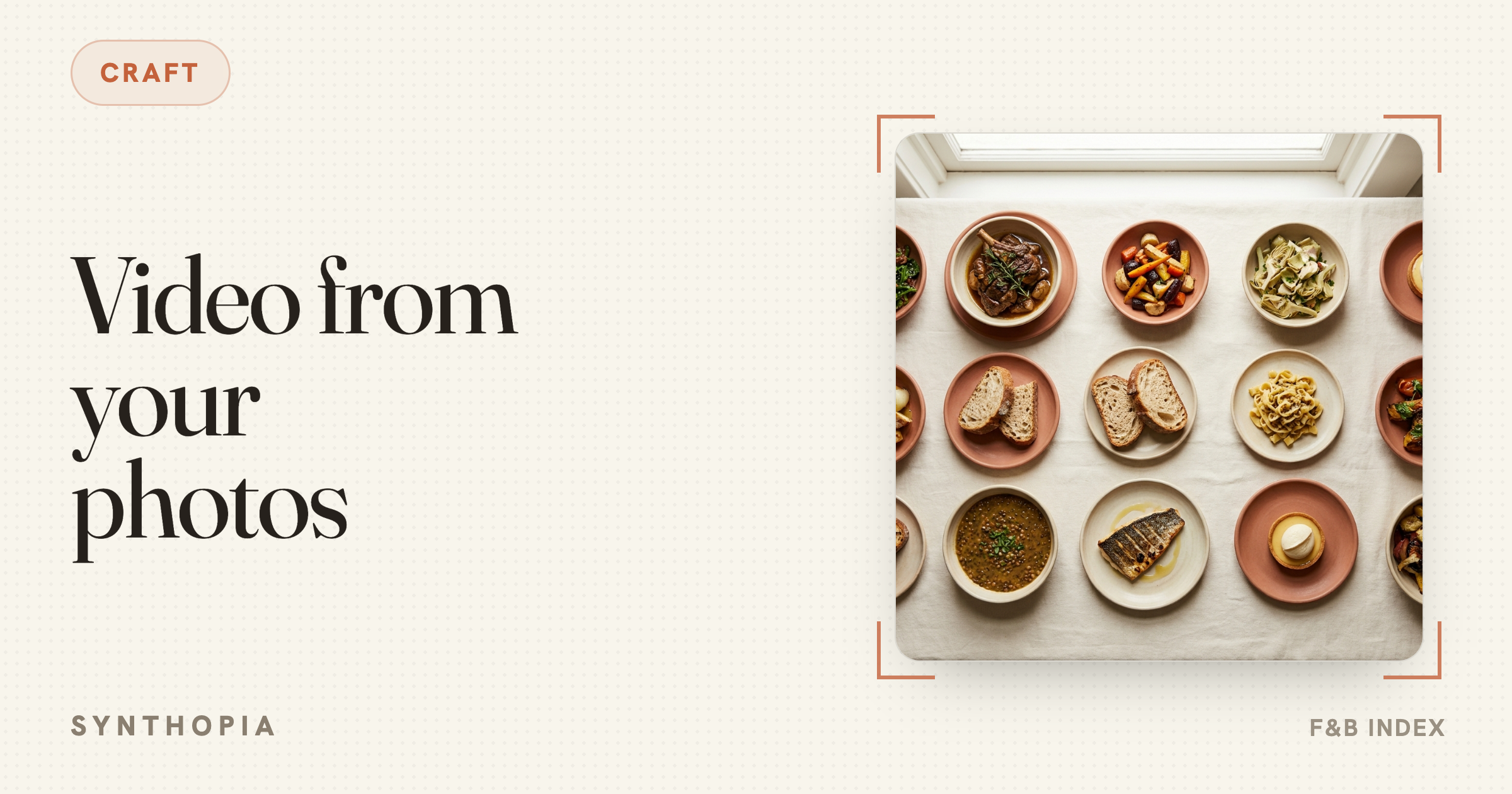
Most "AI food video" looks fake for one plain reason: it invents a dish the restaurant has never plated. The fix isn't a fancier prompt. It's using AI that animates your own real photos of the food you actually serve. Here's the honest path from a photo set to a reel, stills and a carousel that reads as your restaurant, not a stock dining room.

1080x1920, 9:16, up to 180s: Recommended Instagram Reels dimensions and the three-minute max length allowed since January 2025, per Influencer Marketing Hub's video size guide.

under 50,000 followers: Follower band where Reels deliver their highest reach rate, per Socialinsider's 2026 analysis of ~140,000 business Reels.

0.23% vs 0.12%: Restaurants and Cafes Reels engagement rate versus image-post engagement, from Socialinsider 2026.

Why most AI food video looks fake

The uncanny feeling you get from a lot of AI food clips comes from one thing: the plate isn't real. A generic generator builds a burger from scratch, gives it thirty grill marks no kitchen produces, and sets it on a table that doesn't exist. Diners clock it instantly, and it quietly tells them you don't know what your own food looks like. That's the invented-plate problem, and it's why "AI reels" got a reputation. The whole game is the opposite: keep every frame anchored to a real photo of a dish you actually serve. The moment the source is your own kunafa or your own shakshuka, the fake look is gone. Real, not imagined, is the only rule that matters here.

What you need before you start

You don't need a film crew, but you do need honest photos. Before anything else, build a small set of well-lit shots of dishes that are genuinely on the menu. A workable set for a Dubai cafe:

  • Three or four hero dishes, shot straight down and at a low 45-degree angle, in daylight near a window if you can.
  • One or two ambience frames: the counter, the pass, a corner of the room in Al Quoz or the terrace in JBR.
  • A pour or a steam shot if you have one, because movement reads well on video.

Shoot on a clean surface, wipe the plate rim, and keep the phone steady. Ten good frames beat fifty rushed ones. This library is the raw material every video and still comes out of, so it's worth the twenty minutes.

From photos to a 15-second master reel

Once you have the set, the job is to make those stills move. AI built for this animates your real photos: a slow push on the plate, steam drifting, a gentle rack of focus from the coffee to the room behind it. You're not generating new food, you're giving the food you photographed a bit of life. Aim for a 15-second master reel. Influencer Marketing Hub's video size guide puts the sweet spot at 1080 by 1920 pixels in a 9:16 vertical frame, and notes Instagram has allowed Reels up to three minutes since January 2025, though shorter clips still travel furthest to people who don't follow you yet. Fifteen seconds, one clear hero dish, one line of on-screen text. That's the master everything else is cut from.

Stop guessing what to post.Synthopia turns one three-minute brief into a month of campaigns, built from your own photos.Preview yours free

One brief, cut for every feed

The reason this beats a one-off shoot is reuse. From a single brief you cut the same footage into a vertical Reel, a square feed post, a 9:16 Story, a stills carousel and the ambience clip, each sized correctly for its home instead of one video jammed everywhere. That volume is what the algorithm rewards. Socialinsider's 2026 study of around 140,000 business Reels found Reels pull their highest reach for accounts under 50,000 followers, where nearly every independent restaurant sits, and put Restaurants and Cafes at a 0.23% Reels engagement rate against 0.12% on plain images. One well-lit dish should give you a week of posts across Instagram, TikTok and your Talabat promo tie-in, not one and done. That's the whole point of doing it from a photo set rather than a single upload.

Keep the caption yours, and hook it to the calendar

A real video with a robot caption still reads as AI. The caption has to sound like the person who runs the place, so use a tool that learns your voice rather than one that defaults to a chirpy house tone with three emojis. Then hook the opening line to what's actually happening in Dubai this week. During Ramadan, lead the reel on the iftar spread or a quiet suhoor plate and shift your posting to the evening window. Around UAE National Day, lean into it. The occasion is the hook that makes someone in Business Bay stop scrolling, and a generic tool has no idea what day it is. Real footage, your words, the right occasion: that's the difference between a post that gets saved and one that gets skipped.

A quick checklist before you post

Run this before anything goes live. It takes a minute and saves you the fake look.

  • Is the dish real? Every frame traces back to a photo of food you actually serve.
  • Does it sound like you? Read the caption aloud. If it isn't how you'd say it, fix it.
  • Right frame, right feed? 9:16 and 1080 by 1920 for the Reel, square for the feed, no black bars.
  • Does it know the week? The hook fits the occasion on your calendar, iftar timing included in Ramadan.
  • Clean and honest? No stray thumb in shot, no invented garnish, halal-appropriate visuals throughout.

Five yeses and you post. This is exactly the loop Synthopia runs from a three-minute brief: your photos in, a master reel and every format cut out, in your voice and on your city's calendar.

Questions owners ask

How do I make a restaurant video with AI without it looking fake?

The fake look almost always comes from invented or stock food, so the fix is to use AI that animates your own real photos rather than generating new dishes. Before: a glossy burger no kitchen ever plated, in a room that isn't yours. After: a slow push on the actual saffron kunafa you shot this morning, steam drifting, in your own cafe. Same technique, opposite result. Keep every frame traceable to a real photo and the uncanny feeling disappears.

Can AI turn my food photos into a video?

Yes. A good tool takes your photo set and animates it into a 15-second master reel, adding motion like a slow zoom, drifting steam or a focus pull, then cuts that into platform sizes. The key is that the frames come from your own images of dishes you actually serve, not a generated dining room. So it's genuinely your restaurant on screen, just given a bit of movement, rather than a synthetic scene dressed up to look like yours.

Do I need a videographer to make restaurant reels?

Not for weekly cadence. A shoot is worth doing a few times a year to refresh your asset set with new dishes and seasons, but you don't need one every week to stay consistent. AI turns the photos you already have into steady video output, which is what the feed rewards. Reserve the videographer for a seasonal refresh, and let a photo-to-video workflow carry the regular posting in between.

Questions owners ask

How do I make a restaurant video with AI without it looking fake?

The fake look almost always comes from invented or stock food, so the fix is to use AI that animates your own real photos rather than generating new dishes. Before: a glossy burger no kitchen ever plated, in a room that isn't yours. After: a slow push on the actual saffron kunafa you shot this morning, steam drifting, in your own cafe. Same technique, opposite result. Keep every frame traceable to a real photo and the uncanny feeling disappears.

Can AI turn my food photos into a video?

Yes. A good tool takes your photo set and animates it into a 15-second master reel, adding motion like a slow zoom, drifting steam or a focus pull, then cuts that into platform sizes. The key is that the frames come from your own images of dishes you actually serve, not a generated dining room. So it's genuinely your restaurant on screen, just given a bit of movement, rather than a synthetic scene dressed up to look like yours.

Do I need a videographer to make restaurant reels?

Not for weekly cadence. A shoot is worth doing a few times a year to refresh your asset set with new dishes and seasons, but you don't need one every week to stay consistent. AI turns the photos you already have into steady video output, which is what the feed rewards. Reserve the videographer for a seasonal refresh, and let a photo-to-video workflow carry the regular posting in between.

Your restaurant, camera-ready

A month of marketing. One brief.

Clone a proven campaign — reel, stills, carousel and every line of copy — rebuilt from your own product and your own room. Your first preview is free.

Preview a campaign free
A month of marketing, one brief.Preview free